

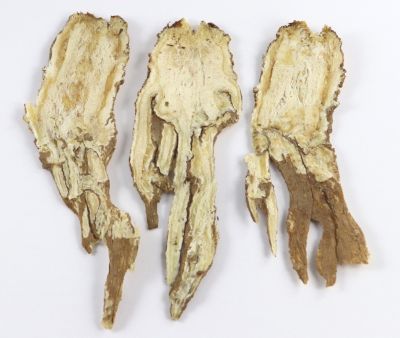
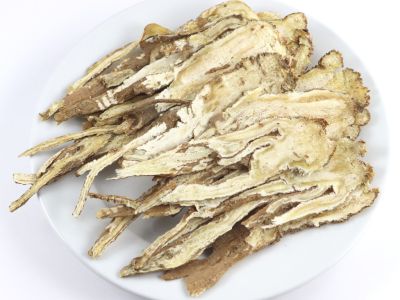
Panax ginseng TaiwanTCM LIANG, slices

Chinese angelica, also dong quai; Latin: Angelica sinensis; Chinese: dang gui
TaiwanTCM Angelica sinensis is high-quality Chinese angelica root. We offer:
Chinese angelica grows in the mountains of central Asia and is one of the basic TCM plants – it is also called “female ginseng”, although botanically it has nothing in common with ginseng. It belongs to the carrot family and in Asia is used in cooking much as we use parsley or celery. It has a very distinctive scent due to its high content of ligustilide – an aromatic phthalic acid derivative, of which good root contains up to 5 %. The content of ligustilide and ferulic acid (another important substance) in Chinese angelica is much higher than in other Angelica species. Besides ligustilide, the scent of the root is rounded off by other phthalides (6,7-epoxyligustilide, butylphthalide, angelicide and butylidenephthalide) and terpenoids (β-cadinene, carvacrol and cis-β-ocimene). Ferulic acid has no scent, because its carboxyl group anchors it firmly in the water phase, but it is a strong antioxidant. Other constituents include vanillic acid and the coumarins angelol G, angelicone and umbelliferone. Chinese angelica also contains proteoglycan polysaccharides.
Chinese angelica may seem a little exotic to us, but its constituents are not. Ligustilide was first isolated from lovage (Ligusticum), and other aromatic substances of angelica are known from other herbs: butylphthalide gives celery (Apium graveolens) its scent, β-cadinene flavours cubeb pepper (Piper cubeba), carvacrol is named after caraway (Carum carvi) and scents marjoram oil, β-ocimene is named after basil (Ocimum) but occurs in the essential oils of many other plants, including hops and lavender. Ferulic acid was named after giant fennel (Ferula), but is common in many plants, as is vanillic acid. Umbelliferone occurs throughout the carrot family. Chemically, Chinese angelica therefore does not stray from the usual range of root vegetables. Its strength lies elsewhere: a strong aroma and a specific combination of highly concentrated constituents.
We are not allowed to give information about health effects here (why); you will find it in the specialist literature.
It is traditionally taken as a decoction. It is also part of one of the most important and best-known TCM herbal mixtures, the all-inclusive great tonifying decoction. The root has an unmistakable aroma that not everyone likes. In Asian cooking, Chinese angelica plays the role of a soup vegetable, roughly like parsley. Chinese angelica is a vegetable and there is no need to fear harmful effects. Its phytochemicals also occur in other root vegetables. Angelica, however, is bred for a high content of aromatic substances, so only a little is needed in food. It has a stronger aroma than parsley or celery, and too much can easily overpower other ingredients.
Chinese angelica is also an ingredient of these mixtures TaiwanTCM: All-inclusive great tonifying decoction, Blood mansion stasis-expelling decoction, Augmented rambling powder. How to prepare a mixture is described on the page herbal mixtures.
Still not sure? Write to us at info@ariadne.cz or call +420 731 590 833, we are happy to help.
Dear customers, I am out of the office from 11 November to 4 December. All your orders will be shipped after my return.
We apologise for the inconvenience. In urgent cases you can reach me via Signal or WhatsApp at +420 731 590 833 or by e-mail at info@ariadne.cz. Kind regards, Stanislava Šindelářová


